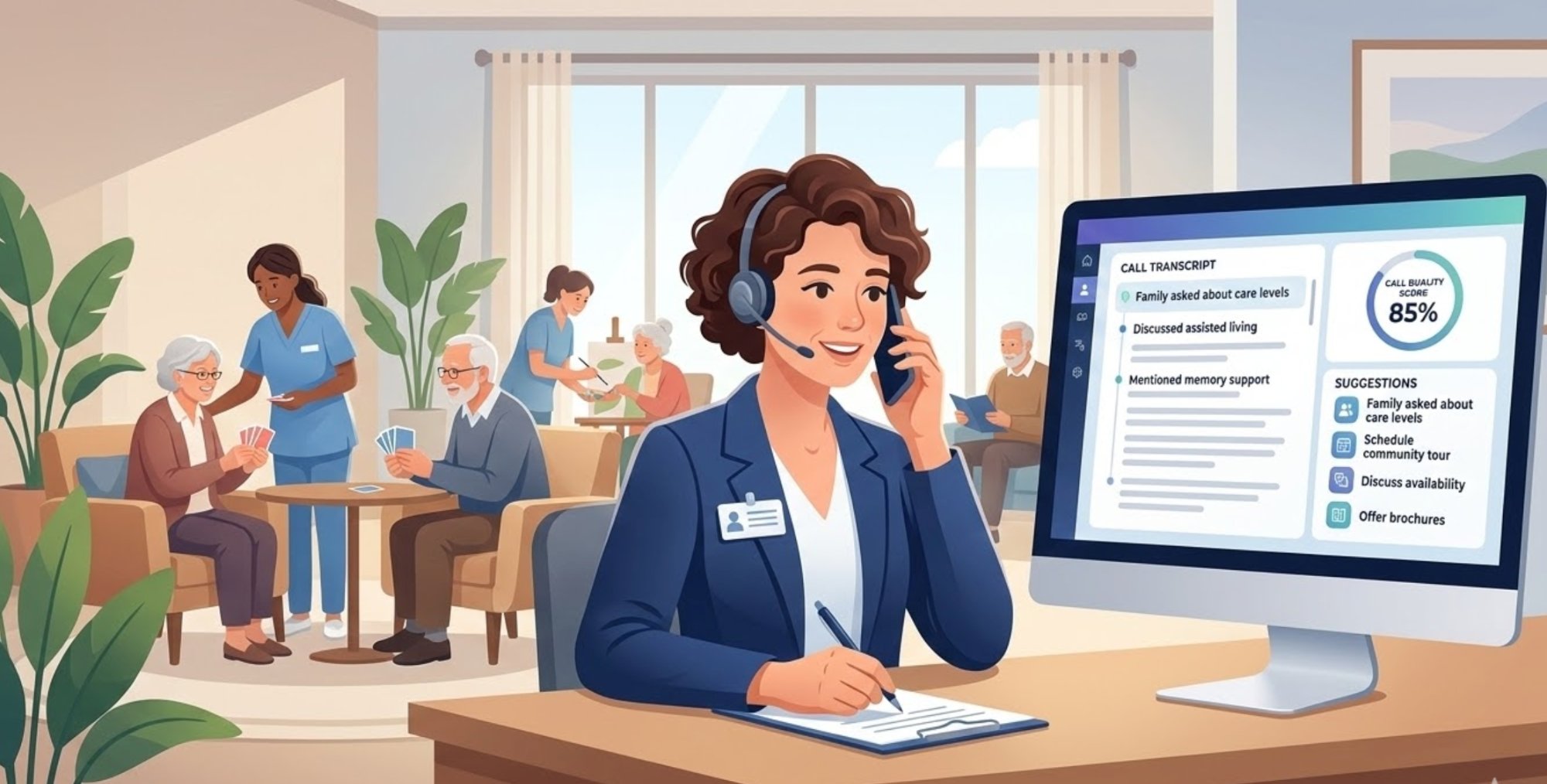
Senior living is among the highest-stakes phone sales environments in any industry. The average monthly fee for assisted living ranges from $3,500 to $7,000 - which means a single moved-in resident represents $42,000 to $84,000 in annual revenue. Multiply that by the average length of stay, and one well-handled phone call is worth hundreds of thousands of dollars over its lifetime.
Yet most communities have no visibility into what their sales counselors are actually saying on those calls. They track tour numbers and move-in rates, but they don't know what's happening in the conversation that determines whether a tour gets booked at all.
of senior living inquiry calls don't result in a scheduled tour
Across communities of all sizes and care levels, roughly half of families who call to inquire never visit in person - and the vast majority were never given a specific, compelling reason to come.
The patterns that cause this are consistent - and almost entirely coachable.
Pattern 1: Leading with features instead of feelings
The most common senior living call sounds like a brochure being read aloud. The counselor lists amenities - the dining program, the activities calendar, the memory care wing, the courtyard. The family listens politely. Then they say "okay, thank you, we'll think about it." And that's the last you hear from them.
Families aren't calling because they want to know your square footage. They're calling because something has changed - a fall, a diagnosis, a moment of frightening clarity that their parent can no longer safely live alone. That emotion is the entire conversation. Until you acknowledge it, nothing else you say lands.
Pattern 2: Answering the pricing question too early
Almost every inquiry call includes a pricing question, usually in the first two minutes. "How much does it cost?" is a reflex - the family is trying to quickly filter out options they can't afford. The counselor who answers with a dollar figure before building any emotional connection has turned a sensitive conversation into a spreadsheet comparison.
Pricing is important and should be addressed honestly. But it belongs in the middle of the conversation - after you've understood the family's situation, established your community's value, and created enough connection that cost is being weighed against something real.
Acknowledge the question, defer the number, earn the context first
"That's an important question and I absolutely want to give you a real answer - it depends on the level of care your mom needs, which is actually something I want to understand better. Our range is $X to $Y depending on care level and apartment size. But before I give you a number that might not fit her situation, can I ask you a few things about what she needs day to day? That way I can tell you exactly what would apply to her."
Pattern 3: Not addressing the guilt
The unspoken thing on almost every senior living inquiry call is guilt. Adult children calling for a parent almost universally feel like they're doing something wrong - like they're giving up on someone they love, or not doing enough. This guilt often shows up as hesitation, over-researching, and stalling on booking a tour.
Counselors who never name this emotion leave families stuck in it. The ones who do - carefully, warmly, without minimizing it - break through to a completely different quality of conversation.
What to listen for: Phrases like "I just want to make sure I'm doing the right thing," "she doesn't really want to move," or "we've been going back and forth on this for a while" are all guilt signals. Each one is an invitation to acknowledge the emotional reality of the situation before continuing with logistics.
Name the guilt and reframe the decision
"I want to say something, because I hear this from almost every family I talk to: the fact that you're this thoughtful about it, that you're doing research and asking the right questions - that's not giving up. That's the opposite. Coming to see us doesn't mean you've made a decision. It just means you're giving yourself the information to make the right one. Can we set up a visit so you can see for yourself what it actually feels like here?"
Pattern 4: The passive close
Senior living counselors often end calls with an open invitation: "feel free to come by anytime" or "just let me know when you want to visit." This is well-intentioned but almost never results in a booked tour. The family is overwhelmed. They have three other communities to call. They're going to get off the phone, feel relief that they did something, and not call back for two weeks.
The counselor's job is to make the next step easy and specific - to carry the family across the action threshold, not leave them at the edge of it.
Always close with a specific time and a low-pressure frame
"I'd love to have you and your mom - or just you, if you want to see it first - come in for a visit. It's about 45 minutes, very relaxed, no pressure at all. You can see the apartments, meet some of our team, and just get a feel for whether this could be the right fit. I have availability this Saturday at 10am or next Tuesday at 2pm - either of those work for you?"
Why this is harder to fix than most industries
Senior living counselors are often selected for empathy, not sales training. They're compassionate people who are good at making families feel heard - but they haven't been taught to close, to handle objections, or to recognize when a conversation has reached its natural booking moment. The result is calls that feel good but don't convert.
The answer isn't to make these conversations less human. It's to give counselors a framework for the moments when empathy alone isn't enough - and the coaching that makes that framework second nature. CallVelocity does exactly that: it coaches on every call, identifies where counselors are losing tours, and surfaces specific language suggestions for the moments that matter most.
Find out where your tour bookings are being lost.
CallVelocity analyzes 100% of your inquiry calls and shows you exactly which conversation patterns are costing you move-ins. Book a demo - we'll analyze a real call live.
Book a Free DemoNo credit card · No commitment · 15 minutes