Preschools and childcare centers compete intensely for enrollment. They invest in signage, social media, local ads, and word-of-mouth referrals to get the phone ringing. But the moment the phone is answered, most of that effort is handed off to a staff member with no formal sales training and no script - and the results reflect it.
The goal of every inquiry call is simple: book the tour. Not explain everything about the program. Not quote the tuition. Not list the staff ratios. Those things matter - but they matter most when a parent is standing in your lobby, seeing the environment with their own eyes, watching how your teachers interact with children. The call exists to create that moment, not replace it.
of preschool inquiry calls don't result in a scheduled tour
More than half of parents who reach out to a childcare program never come in for a visit - most were overwhelmed with information and never given a clear, easy next step.
Here's what's going wrong - and what the highest-converting programs do differently.
Pattern 1: Information overload before the parent feels heard
The most common preschool inquiry call goes like this: a parent says "I'm looking for childcare for my two-year-old." The staff member immediately launches into the program: "We offer part-time and full-time options, our hours are 7am to 6pm, we follow a play-based curriculum, we have a 6:1 ratio in the toddler room, tuition is $1,400 per month for full-time..." The parent is quiet, processing. Eventually they say "okay, thanks, I'll think about it."
What the parent actually needed in that moment wasn't information - it was to feel like someone understood what they were going through. Finding childcare for the first time is overwhelming and emotional. The staff member who asks a question before answering one creates an entirely different kind of call.
Pattern 2: Giving tuition before giving value
Tuition is almost always the second or third question a parent asks. Most staff answer it directly - "$1,400 a month for full-time" - and the parent immediately goes quiet or starts comparing to other numbers in their head. The price lands with nothing to attach to.
Tuition should be given in context: after the parent understands what their child's day actually looks like, what the curriculum is built on, who the teachers are, and why families who are already enrolled chose this school. When price follows value, it's evaluated differently.
Answer the price question - but frame it with value first
"Great question. Full-time is $1,400 a month. What that includes is 7am to 6pm, all meals and snacks - so no packing lunches - curriculum materials, and access to all our enrichment activities. Our teachers all have early childhood education degrees, and most of them have been with us for several years, which is actually pretty rare in childcare. A lot of parents find it's comparable to other programs when you factor in everything that's included. But honestly, the best way to understand whether it makes sense is to come see it - can we do a quick visit this week?"
Pattern 3: Losing to "I'm calling a few places"
Parents almost always call multiple preschools. This is expected. What most staff do wrong is treat this as a reason to be less engaged - "sure, take your time, let us know." The parent hangs up and calls the next school on their list, and whoever makes the best impression on that call wins.
The school that says something memorable about why they're worth visiting - not just why they're good, but why an in-person visit will make the decision clear - is the one that books the tour.
Key insight: Parents don't choose a preschool based on a phone call. They choose based on how they feel when they walk in the door. Your job on the call is simply to get them to the door. Everything after that, your program does on its own.
Position the tour as the only way to make a real decision
"Absolutely, you should visit a few places - that's exactly what I'd tell my own sister to do. Here's what I'd suggest: come see us first, because most parents tell us that once they see the classrooms and meet the teachers, the decision gets a lot clearer. It usually takes about 30 minutes. I have tomorrow at 9am or Thursday at 4pm open - either of those work?"
Pattern 4: Not creating urgency around availability
Preschools have limited spots - especially for younger age groups. This is one of the most powerful and honest urgency tools available, and most programs never use it. Staff are worried about sounding pushy, so they say nothing. The parent assumes there's always availability and takes their time deciding. By the time they call back, the spot is gone - and they're frustrated, not the staff.
Tell the truth about availability - early and naturally
"I do want to mention - we only have two spots left in the toddler room right now, and we typically fill up pretty quickly once spring enrollment opens. I'm not trying to pressure you, but I wouldn't want you to do all your research and then find out we're full. That's honestly why I'd love to get you in for a visit sooner rather than later - that way you can hold a spot while you're still looking. Can we do this week?"
The enrollment math that most directors miss
A single preschool enrollment at $1,400 per month is $16,800 in annual tuition. Siblings often follow. Families refer other families. A parent who enrolls their two-year-old may stay for four years across two children - that's well over $100,000 in lifetime enrollment value from a single tour booking.
Most childcare directors are so close to their program that they've stopped seeing the phone call as a business-critical moment. It is. Every inquiry call that doesn't book a tour is lost revenue that compounds - not just one enrollment, but the referral network that family would have brought with them.
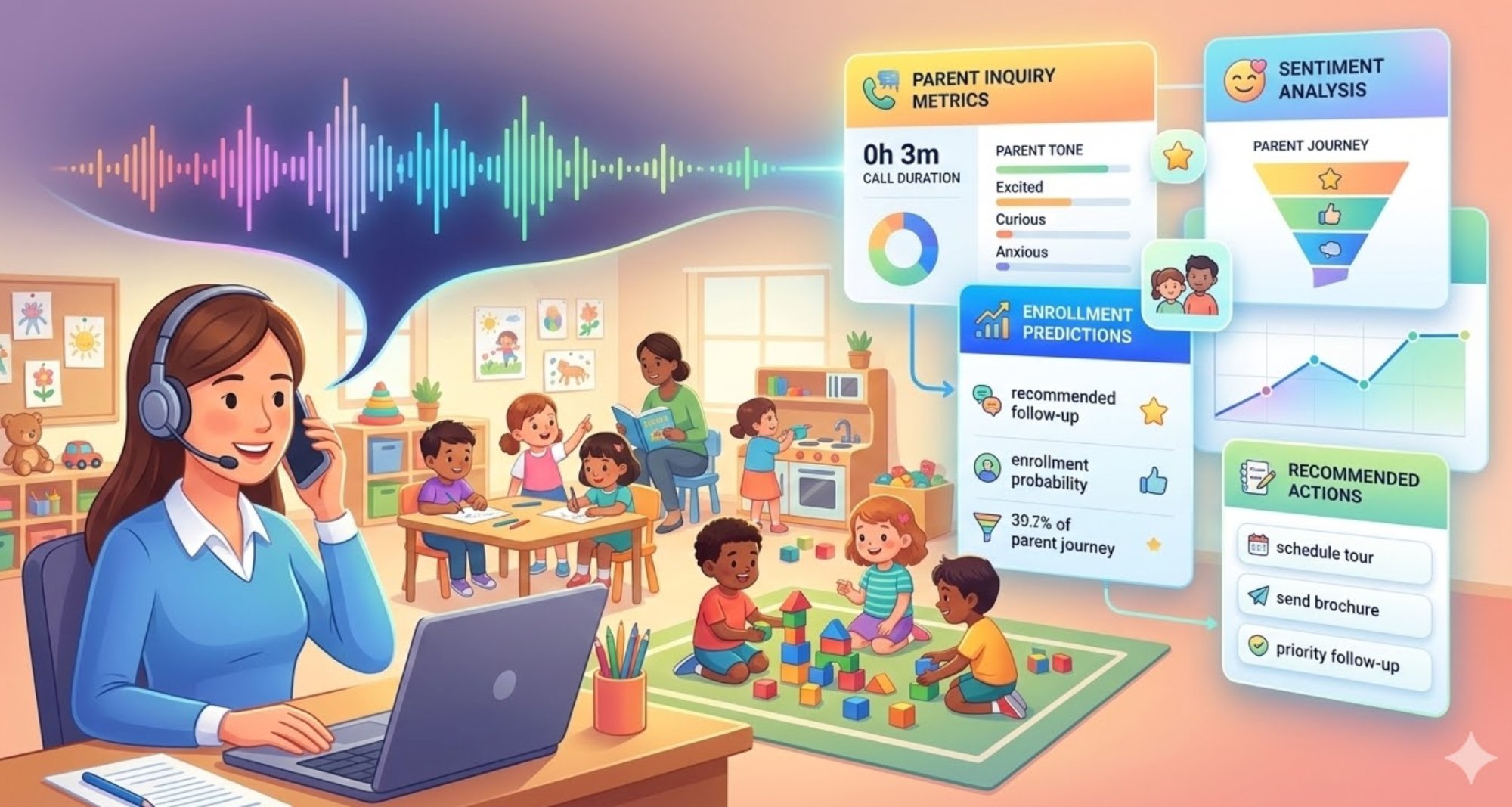
CallVelocity gives preschools and childcare centers the same visibility into their call performance that high-growth businesses have had for years. Every call becomes a coaching moment, every missed tour booking gets flagged, and your team gets the training so the next call goes better than the last.
See how many enrollment tours your calls are actually booking.
CallVelocity analyzes 100% of your inbound inquiry calls and shows you exactly where parents are hanging up without scheduling. Book a demo - we'll analyze a real call live.
Book a Free DemoNo credit card · No commitment · 15 minutes